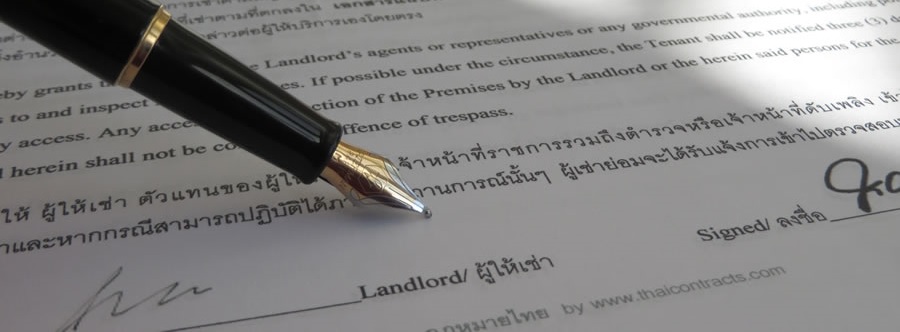
In Thailand, whether an agreement is described as a rental, tenancy, lease or leasehold, it is generally governed by the Civil and Commercial Code under the chapter Hire of Property. In legal terms, a lease exists where the owner of a property (the lessor) grants another person (the lessee) the right to possess and use the property for a specified period in return for rent. This forms the legal basis for property lease agreements in Thailand
Practical Legal Notes – Thailand Land Lease Agreement คำอธิบายข้อกฎหมายประกอบสัญญาเช่าที่ดินในประเทศไทย
Last reviewed: July 2026 | อัปเดตและตรวจทานล่าสุด: กรกฎาคม 2569
Introduction
บทนำ
A long-term land lease is one of the most common legal structures used by foreigners who wish to occupy or invest in property in Thailand. While the Civil and Commercial Code permits registered leases of up to thirty years, the legal protection offered by a lease depends not only on registration but also on the way the transaction has been structured.
These Practical Legal Notes explain the legal principles relevant to the accompanying lease agreement. They are intended as general legal guidance and should be read together with the lease agreement, questionnaire and instructions included in this document package.
Property leases in Thailand are primarily governed by the Civil and Commercial Code under the chapter Hire of Property (Sections 537–571). These provisions apply equally to Thai nationals and foreigners. Their practical application has been further clarified through Supreme Court decisions interpreting the Civil and Commercial Code.
Only in limited commercial situations may the Lease of Immovable Property for Commerce and Industry by Foreigners Act B.E. 2542 (1999) apply. This legislation is intended for qualifying commercial investment projects and does not generally apply to ordinary residential leases.
Long-term leases must also comply with Land Office registration requirements and administrative practice. Clauses that conflict with Thai law or Land Office regulations, such as provisions intended to create ownership-like rights for a foreign lessee or prepaid and guaranteed lease renewals beyond the statutory thirty-year maximum, are generally not accepted for registration.
Under current Land Office practice, registration officials are required to refuse registration where a lease contains provisions that clearly conflict with applicable law or official Land Office regulations.
Registration at the Land Office
การจดทะเบียนสัญญาเช่าที่สำนักงานที่ดิน
A lease for a term exceeding three years must be made in writing and registered at the Land Office to be enforceable beyond the initial three-year period. Shorter leases do not require registration, although written evidence is generally required to enforce the lease by legal action.
Upon registration:
the lease is recorded on the title deed and in the Land Office records;
the parties sign the official Thai Land Office lease form (Tor Dor 11);
the registered lease becomes binding upon subsequent purchasers of the property, subject to the limits imposed by Thai law.
The official Land Office lease form is not the lease agreement itself. It records only the essential particulars of the registered lease. The parties' rights and obligations are primarily contained in the private lease agreement executed between the lessor and the lessee.
For this reason, the private lease agreement should be clearly referred to in the Land Office documentation and, where appropriate, attached to the registration documents.
The questionnaire included with this lease package has been designed as a practical due diligence checklist covering many of these issues. It assists the parties in identifying matters that should be clarified before the lease agreement is signed and, where applicable, registered at the Land Office.
Does Every Lease Require Registration?
สัญญาเช่าทุกฉบับต้องจดทะเบียนหรือไม่
Not necessarily. Registration is only required where the lease exceeds three years or where the parties intend the lease to remain enforceable against subsequent purchasers of the property in accordance with Thai law.
Although registration is not required for shorter leases, Thai courts have in some circumstances afforded additional protection to lessees, particularly where the lease forms part of a broader reciprocal contractual arrangement. Whether such protection is available depends on the specific facts of the case and should not be regarded as a substitute for registration where registration is required by law.
Does a Lease Require Rent?
สัญญาเช่าต้องกำหนดค่าเช่าหรือไม่
Yes.
A lease requires consideration. The rental amount should be genuine and commercially reasonable.
If an unrealistic rent is stated solely to facilitate registration, the authorities may assess the lease value according to official valuation methods for tax and registration purposes.
Why the Structure of the Lease Matters
เหตุใดโครงสร้างของการเช่าจึงมีความสำคัญ
Many legal issues associated with long-term leases are not caused by the statutory thirty-year lease limit itself, but by the way the transaction has been structured from the outset.
For foreign lessees making a substantial residential investment, it is often advisable to consider whether:
for a foreign lessee, the land should be leased separately from any existing building, rather than leasing both under a single lease agreement;
where the lease concerns vacant land, ownership of any future building should be addressed from the beginning;
ownership of an existing building should first be transferred separately before registering a right of superficies, where appropriate, taking into account the applicable transfer taxes and registration fees;
a registered right of superficies would provide additional protection for ownership of the building;
multiple lessees should be registered where continuity for spouses or family members is intended;
succession and continuity should be addressed separately within the overall legal structure.
The most appropriate structure depends on the intended use of the property, the parties involved and the nature of the investment.
A properly structured transaction often provides greater legal certainty than attempting to strengthen the wording of the lease agreement itself.
Leasing Property From a Thai Spouse
การเช่าทรัพย์สินจากคู่สมรสชาวไทย
Section 1469 of the Civil and Commercial Code provides that agreements concluded between spouses during the marriage may generally be revoked by either spouse during the marriage or within one year after its dissolution.
Accordingly, a lease between spouses should not automatically be regarded as providing the same legal protection as a lease concluded between unrelated parties.
Where property is acquired in the name of the Thai spouse using funds provided wholly or partly by the foreign spouse, additional legal issues concerning marital property, reimbursement claims and unjust enrichment may arise.
A signed declaration or waiver stating that the purchase funds originated from one spouse does not, by itself, determine the legal character of the property. Under Thai marital property law, the actual source of the funds, the purpose of the payment and the surrounding circumstances are generally more important than the wording of any declaration signed by the parties.
Under Thai law, the maximum lease term is thirty years. Any lease providing for a longer term is automatically reduced by law to thirty years.
A contractual promise to renew the lease should not be confused with a further registered lease term. Renewal requires a new lease agreement and a new registration at the Land Office.
A renewal clause is essentially a contractual promise by the lessor to enter into a new lease in the future. It does not automatically create a second registered lease and does not bind a purchaser of the land who was not a party to the original agreement.
Even where the land remains owned by the original lessor, a refusal to execute a new lease may leave the lessee with no practical alternative other than legal proceedings, where the prospects of obtaining a further registered lease are generally limited.
For this reason, the accompanying lease agreement does not attempt to create prepaid, automatic or guaranteed lease renewals extending the statutory maximum lease period.
Transfer of Land Ownership
ผลของการโอนกรรมสิทธิ์ในที่ดินต่อสัญญาเช่า
The transfer of ownership of leased land does not, by itself, terminate a properly registered lease. Subject to Thai law, the purchaser acquires the land together with the registered lease.
However, not every provision contained in the private lease agreement automatically binds a subsequent purchaser. Only rights that are legally recognised as lease rights under Thai law continue to bind a new owner of the land.
Contractual provisions that go beyond the legal rights of a lease, such as renewal promises or certain succession arrangements, may remain enforceable only between the original contracting parties. Whether a particular clause binds a subsequent purchaser depends upon the nature of the right created and the applicable provisions of Thai law.
For this reason, careful drafting and an appropriate legal structure are often more important than simply including additional clauses in the lease agreement.
Where the property consists of both land and an existing house, it is often worth considering whether the land should be leased while ownership of the building is transferred separately to the lessee. In many cases, this results in a simpler and more practical legal structure than leasing both the land and the building under a single lease agreement.
Separate ownership of the building reduces many of the contractual issues that commonly arise under combined land-and-house leases, such as maintenance obligations, deterioration, alterations, insurance and the condition in which the property must be returned at the end of the lease. The lease can then focus solely on the land, while ownership and use of the building are governed separately.
Where accepted by the Land Office, a registered right of superficies may further strengthen the legal position by protecting separate ownership of the building.
For many long-term residential investments, careful planning of the legal structure is often more important than attempting to strengthen the wording of the lease agreement. Whether the land and the building should form part of the same legal arrangement or be dealt with separately depends on the particular property, the parties involved and the intended long-term use of the investment.
Building on Vacant Land
การก่อสร้างบนที่ดินเปล่าที่เช่า
Where the lease concerns vacant land and the lessee intends to construct a house or other building, the legal structure should be considered before construction begins rather than after the building has been completed.
Particular consideration should be given to:
whether the lease permits the intended use and construction;
whether a registered right of superficies would be appropriate;
whether the cooperation of the landowner will be required for registration of additional rights;
building restrictions or other contractual limitations affecting future construction;
access rights and registered servitudes necessary for the intended use of the property.
If the parties intend to register a right of superficies, the cooperation of the landowner is required. This should therefore be considered at the outset of the transaction rather than after construction has commenced.
Where construction is intended, practical matters such as the building permit, construction contract, ownership evidence, house registration (Tabien Baan), utility connections and related documentation should, where legally and practically possible, be arranged in the name of the lessee rather than the landowner.
Leasing from a Property Developer
การเช่าจากผู้พัฒนาโครงการ
Leasing property from a licensed developer generally reduces certain practical risks relating to land title, infrastructure and project development. However, it should not be assumed that leasehold structures offered by developers provide the same legal protection as the purchase of a condominium unit.
The statutory consumer protection rules that apply to residential sale agreements do not generally apply to long-term lease arrangements. The rights and obligations of the parties therefore depend primarily upon the lease agreement and the applicable provisions of Thai law.
Particular attention should also be paid to the overall legal structure of the development. In some leasehold projects, ownership of the common areas, voting rights or long-term control of the development may remain with the developer or related companies. These matters should be reviewed carefully before entering into a long-term lease.
A lease is primarily a contractual right. Where the parties intend the lease to continue following the death of the lessee, succession should be expressly addressed in the lease agreement.
Without appropriate succession provisions, questions may arise as to whether particular rights continue following the death of the lessee and to what extent those rights remain protected under Thai lease law.
Although Thai courts have, in certain circumstances, recognised continued protection for a lessee or the lessee's heirs, these decisions depend upon their particular facts. Whether a particular contractual provision continues as a protected lease right, or merely remains a personal contractual obligation between the original parties, cannot be assumed and should not be left to later interpretation.
Where continuity for a spouse or family members is important, this should be considered when the lease is drafted rather than after it has been registered.
Where appropriate, registering multiple lessees may provide an additional level of continuity, as the surviving lessee(s) may continue to exercise the lease rights independently following the death of one of the lessees.
Assignment and Subleasing
การโอนสิทธิการเช่าและการเช่าช่วง
A lease cannot be assigned or subleased without the consent of the lessor.
Under Section 544 of the Civil and Commercial Code, the lessee may not assign the lease or sublet the property, in whole or in part, without the consent of the lessor.
Where assignment or subleasing is intended, the lease agreement should expressly provide for it.
Many legal disputes concerning long-term leases arise not because of defects in Thai lease law itself, but because of misunderstandings about how the law operates in practice.
Common examples include:
assuming that registration makes every lease provision legally enforceable;
believing that a renewal clause creates a sixty-year or ninety-year lease;
assuming that a lease can create ownership-like rights over land;
leasing both the land and the building without considering whether separate ownership of the building would provide a more suitable legal structure;
failing to carry out adequate legal and practical due diligence before signing the lease;
assuming that all lease rights automatically continue following the death of the lessee;
overlooking the effect of Thai marital property law when leasing property between spouses.