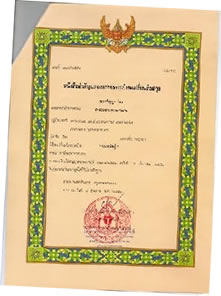
A Thai prenuptial agreement is a written contract made before marriage and registered together with the marriage at the District Office (Amphur/Khet) to record personal property and rules for managing marital property under Thai law. Under Section 1466 of the Thai Civil and Commercial Code, a prenuptial agreement must be registered together with the marriage at the district office (Amphur/Khet) to be legally valid.
This article is intended for expats and foreign nationals who plan to marry a Thai citizen and want a practical understanding of how Thai marriage and prenuptial laws actually work in practice.
In Thailand, a prenuptial agreement is legally recognized under the Civil and Commercial Code, Section 1465. For expats and foreigners marrying in Thailand, a valid prenup is the only legally accepted way to regulate property ownership before marriage.
To be legally valid, a prenuptial agreement must meet all of the following conditions:
It must be made in writing
It must be signed by both parties
It must be signed in the presence of at least two witnesses
It must be registered at the District Office (Amphur)
Registration must take place at the same time as the marriage registration
If any of these requirements are not met, the prenuptial agreement is void and unenforceable under Thai law.
Registration of a Prenuptial Agreement at the District Office
A prenuptial agreement in Thailand must be registered at the same District Office (Amphur/Khet) where the marriage is recorded. This is also where the Kor Ror 2 (marriage registration form) is prepared and the Kor Ror 3 marriage certificate is issued.
Thai law allows two registration formats. For short and simple agreements, the registrar may record a brief summary of the prenup directly in the remarks section of the Kor Ror 2. While this method is quick, it provides limited space and usually does not include detailed asset schedules.
For longer or bilingual agreements — which are common where one spouse is a foreign national — the full signed prenuptial agreement, including asset schedules, can be physically attached to the Kor Ror 2 register. The registrar will then note that a prenuptial agreement has been attached. This method provides clearer and more complete evidence of each spouse’s personal property.
If an Amphur is reluctant to register a prenuptial agreement, couples should politely refer to Section 1466 of the Civil and Commercial Code, which requires that a valid prenup be registered together with the marriage. It is advisable to contact the Amphur a few days in advance to confirm the preferred registration format and whether an appointment is required, particularly in larger cities or tourist areas.
Amendments After Marriage
After the marriage has been registered, a prenuptial agreement cannot be added to or amended. Any changes are only possible with court approval, which is rarely granted and requires strong legal justification.
Agreements Between Spouses During Marriage
Under Section 1469 of the Civil and Commercial Code, agreements made between husband and wife during marriage — including gifts and property arrangements — are considered voidable. This means such agreements can be challenged and invalidated by the court.
Limits of Contract Freedom in Thai Prenups ข้อจำกัดของเสรีภาพในการทำสัญญาก่อนสมรสตามกฎหมายไทย
Purpose and Scope
A Thai prenuptial agreement (“prenup”) is a written contract made before marriage and registered together with the marriage. Its main function is to set out how assets are treated under Thai law, especially the distinction between personal property (sin suan tua) and marital property (sin somros).
In practice, a Thai prenup is most effective when it focuses on:
Identifying which assets are personal property (owned by one spouse)
Confirming which assets may become marital property (jointly managed/owned under Thai rules)
Establishing rules for the management and control of marital property (for example, who manages, signs, or approves transactions)
Legal Limits Under Thai Law
The scope of a Thai prenup is limited. Any clause that conflicts with Thai law or public order can be treated as void or voidable and may be set aside by the court during a divorce.
This means a prenuptial agreement generally cannot reclassify assets in a way that contradicts the Civil and Commercial Code. It cannot “turn” personal property into marital property (or vice versa) if that conflicts with the legal definitions, and it cannot waive or remove statutory protections that apply to spouses. In general, sin somros (marital property) is divided equally upon divorce, and a prenup cannot simply contract out of that where doing so would conflict with the Code or undermine spouse protections.
Compared to Many Foreign Legal Systems
Many foreigners are used to legal systems that allow broader contractual freedom in prenuptial agreements. Thailand is different: a prenup must stay within the boundaries of the Thai Civil and Commercial Code and must not conflict with public order or good morals.
In addition, a Thai prenuptial agreement should be drafted under Thai law. Clauses attempting to make a foreign law govern the spouses’ property relations may be treated as invalid for use in Thailand, meaning Thai mandatory rules will still apply (especially in divorce proceedings).
By contrast, some foreign jurisdictions may allow a separate agreement to be governed by their own law (or recognize a valid choice-of-law arrangement) for assets or proceedings in that jurisdiction, subject to local conflict-of-law rules. This is one of the main reasons international couples often use a dual approach: a Thai prenup for Thailand, plus a separate foreign-law agreement for overseas assets and enforcement.
Our prenup package is structured for this dual approach and includes relevant clauses designed to anticipate parallel agreements in other jurisdictions. View the prenup package.
Dual Prenup Strategy for Expats
For this reason, many expats entering a Thai marriage use a dual-system approach:
A Thai prenup for assets and enforcement within Thailand
A separate prenup (or marital agreement) under the law of another country (e.g., nationality or where major assets are located)
This approach can help reduce cross-border uncertainty. Our prenuptial agreement package is specifically designed to support this dual-system strategy and includes carefully drafted clauses anticipating parallel agreements under foreign law.
Prenuptial Agreements and Divorce in Thailand สัญญาก่อนสมรสกับการหย่าในประเทศไทย
How Thai Prenuptial Agreements Are Treated in Divorce
In Thailand, the role of a prenuptial agreement becomes particularly important in the event of divorce. How a divorce is handled — and how property is divided — depends on whether the spouses agree or whether the matter must be decided by the court.
Administrative Divorce at the District Office (Amphur)
Where both spouses mutually agree to divorce, they may register an administrative divorce at the District Office (Amphur). In such cases, the spouses are free to agree on the division of assets and may use their prenuptial agreement as guidance when drafting their divorce settlement.
Court Divorce and Judicial Property Division
If the spouses cannot agree, the divorce — including property division — must be decided by a Thai court. Thai family courts will primarily apply the Civil and Commercial Code (Book V: Marriage), as Thailand follows a civil law system.
Courts will enforce prenuptial agreement provisions only to the extent that they do not conflict with mandatory law or public order and good morals. Any clause that contradicts Thai law may be declared void or unenforceable.
Equal Division of Marital Property
Under Section 1533 of the Civil and Commercial Code, marital property (sin somros) must be divided equally upon divorce. Any prenuptial clause attempting to override this principle may be declared invalid.
Importance of Asset Classification and Evidence
A key practical value of a prenuptial agreement is the clear identification of personal property. This carries significant evidentiary weight. In cases of doubt, Thai courts generally presume that an asset is marital property and therefore subject to equal division.
For example, where a foreign spouse purchases a house in Thailand that is registered in the Thai spouse’s name under land office regulations, this registration alone does not override the Civil and Commercial Code’s rules on personal and marital property. The court will assess ownership based on evidence, not registration formality alone.
Proper documentation — such as consistent asset records, declarations, or schedules updated during the marriage — strengthens the evidentiary value of a prenup. Without clear accounting, valuation becomes complex and the court has broad discretion to decide based on available evidence and circumstances.
Common Prenup Mistakes Foreigners Make in Thailand ข้อผิดพลาดที่ชาวต่างชาติมักทำเกี่ยวกับสัญญาก่อนสมรสในประเทศไทย
Common Mistakes in Thai Prenuptial Agreements
Foreigners marrying in Thailand often assume that a prenuptial agreement will work the same way as in their home country. In practice, Thai law imposes strict formal and substantive limits, and these misunderstandings can make a prenup ineffective or partly unenforceable.
Signing the Prenup Too Late
A Thai prenuptial agreement must be made before marriage and registered or attached to the marriage register on the same day the marriage is registered. If the agreement is signed or filed after the wedding, it is not a valid Thai prenup under the Civil and Commercial Code.
Trying to Override Thai Statutory Property Rules
A prenuptial agreement cannot override the mandatory classification rules of Thai law. For example, income earned during marriage and the fruits of property, such as rent, dividends, and interest, remain marital property even if the agreement attempts to classify them as personal property.
Failing to Clearly List Personal Assets and Debts
Many couples do not attach detailed schedules of the assets and liabilities each party owns before marriage. Without clear annexes and supporting documents, it may later be difficult to prove that a particular asset was personal property rather than marital property.
Using a Foreign Template Without Adapting It to Thai Law
Prenuptial agreements drafted for use in other countries often contain clauses that do not fit Thai family law. Provisions that conflict with Thai law, public order, or good morals may be void or unenforceable in Thailand.
Assuming Land Registration Settles Ownership
Where land or a house is registered in the Thai spouse’s name because the other spouse is a foreigner, that registration formality does not by itself determine whether the property is personal or marital under the Civil and Commercial Code. Thai courts will still consider the true source of funds, tracing, and evidence.
A properly drafted Thai–English prenuptial agreement, signed before marriage and correctly registered on the wedding day, can reduce these risks and provide clearer evidence if a dispute later arises.
How does a Thai prenuptial agreement affect divorce and property division?
If you and your spouse cannot agree on issues such as asset division, a Thai court will decide the case primarily under the Civil and Commercial Code. A valid prenuptial agreement can be strong evidence—especially for identifying personal property.
However, marital property must still be divided equally under Thai law, and what counts as marital property is determined by the Civil and Commercial Code (not by the prenup). Provisions that conflict with mandatory law or public order/good morals may be treated as void or unenforceable.
FAQ: Limits & Purpose of a Thai Prenuptial Agreement คำถามที่พบบ่อย: ขอบเขตและวัตถุประสงค์ของสัญญาก่อนสมรส
How important is a prenuptial agreement under Thai law?
A Thai prenuptial agreement has a limited but practical role. Thai law automatically creates a statutory marital property regime upon marriage, and this framework cannot be fully excluded by contract.
Even without a prenup, personal property remains personal property under Thai law. However, a properly drafted and registered prenup can provide clear written evidence of what each spouse owns personally—often crucial at divorce or death.
Can a Thai prenup exclude marital property or apply foreign law?
In general, a Thai prenuptial agreement cannot override mandatory provisions of Thai law. The legal definition of marital property is set by statute and cannot be freely changed by agreement.
Likewise, applying foreign marital property law in Thailand is often problematic in practice. For Thai registrations and Thai assets, a prenup should comply with Thai law and Thai formal requirements.
FAQ: Changing the Character of Property by Prenup
คำถามที่พบบ่อย: การเปลี่ยนลักษณะทรัพย์สินด้วยสัญญาก่อนสมรส
Can a Thai prenuptial agreement change personal property into marital property?
Yes, in limited circumstances. Under the Civil and Commercial Code, a prenuptial agreement made before marriage and registered at the time of marriage may regulate property relations between spouses, provided it does not conflict with mandatory law or public order.
The Thai Supreme Court has confirmed that spouses may validly agree, in a properly registered prenuptial agreement, that a specific asset which would otherwise be personal property shall be treated as marital property.
What is the significance of Supreme Court Decision No. 6711/2537?
In Supreme Court Decision No. 6711/2537 (B.E. 2537), the Court held that where spouses clearly recorded in their prenuptial agreement that certain immovable property would be treated as marital property, and the agreement was registered at marriage, such provision was enforceable.
The Court emphasized that the agreement did not violate public order or good morals, and therefore could validly alter the classification of the specified property between the spouses.
Can a prenuptial agreement determine the character of immovable property purchased during marriage?
As a general rule, the Civil and Commercial Code provides that property acquired during marriage is marital property, unless it falls within statutory exceptions.
A prenuptial agreement may clarify or confirm how future property acquisitions are to be treated between spouses. However, such provisions cannot override mandatory law and must be interpreted together with statutory rules on marital property.
In the case of land and other immovable property, registration under Thai land law—particularly where land must be registered solely in the name of a Thai spouse—does not automatically determine the classification of the property between spouses for purposes of divorce.
By ThaiContracts Legal Team — Thai & International Legal Professionals | จัดทำโดยทีมกฎหมาย ThaiContracts — ผู้เชี่ยวชาญ ด้านกฎหมายไทยและกฎหมายระหว่างประเทศ
Get Your Prenuptial Agreement Template
Download our bilingual Thai–English prenuptial agreement template—built for expats and structured for Amphur/Khet registration. It’s easy to complete and includes practical instructions for preparing it before your marriage appointment. ดาวน์โหลดแบบสัญญาก่อนสมรสภาษาไทย–อังกฤษของเรา—จัดทำสำหรับชาวต่างชาติและจัดโครงสร้างให้เหมาะกับ การจดทะเบียนที่อำเภอ/เขต สามารถกรอกได้ง่าย และมีคำแนะนำในการเตรียมเอกสารก่อนวันนัดจดทะเบียนสมรส